


1. “Directly on the lake” and “front row” are not the same
The key distinction concerns your booked category, not simply the campsite itself. A resort may border Lake Garda and still have pitches or mobile homes arranged across several rows and zones. If you want to see the water from breakfast or carry a SUP to the shore in a few steps, look for wording such as “first row”, “lake”, “lakeside” or a clearly marked waterfront location.
The reverse can also be true: accommodation farther back may be quieter, shadier or closer to sanitary facilities, the pool and playground. For families, the supposedly second-best lake position can therefore be the more practical one.
2. Open the campsite map before you book
On large resorts, the site map is one of the most useful decision tools. Check where your accommodation category sits in relation to the lake, pool, sanitary blocks, restaurants, entertainment, playgrounds and entrance. If a booking platform names only the accommodation type but does not guarantee the exact pitch, do not assume a particular row.
Caravan and large-motorhome travellers should also consider access and manoeuvring room. An attractive old waterfront zone may be tighter or more heavily planted than a newer, more spacious section farther inland.
3. Not every beach is the same
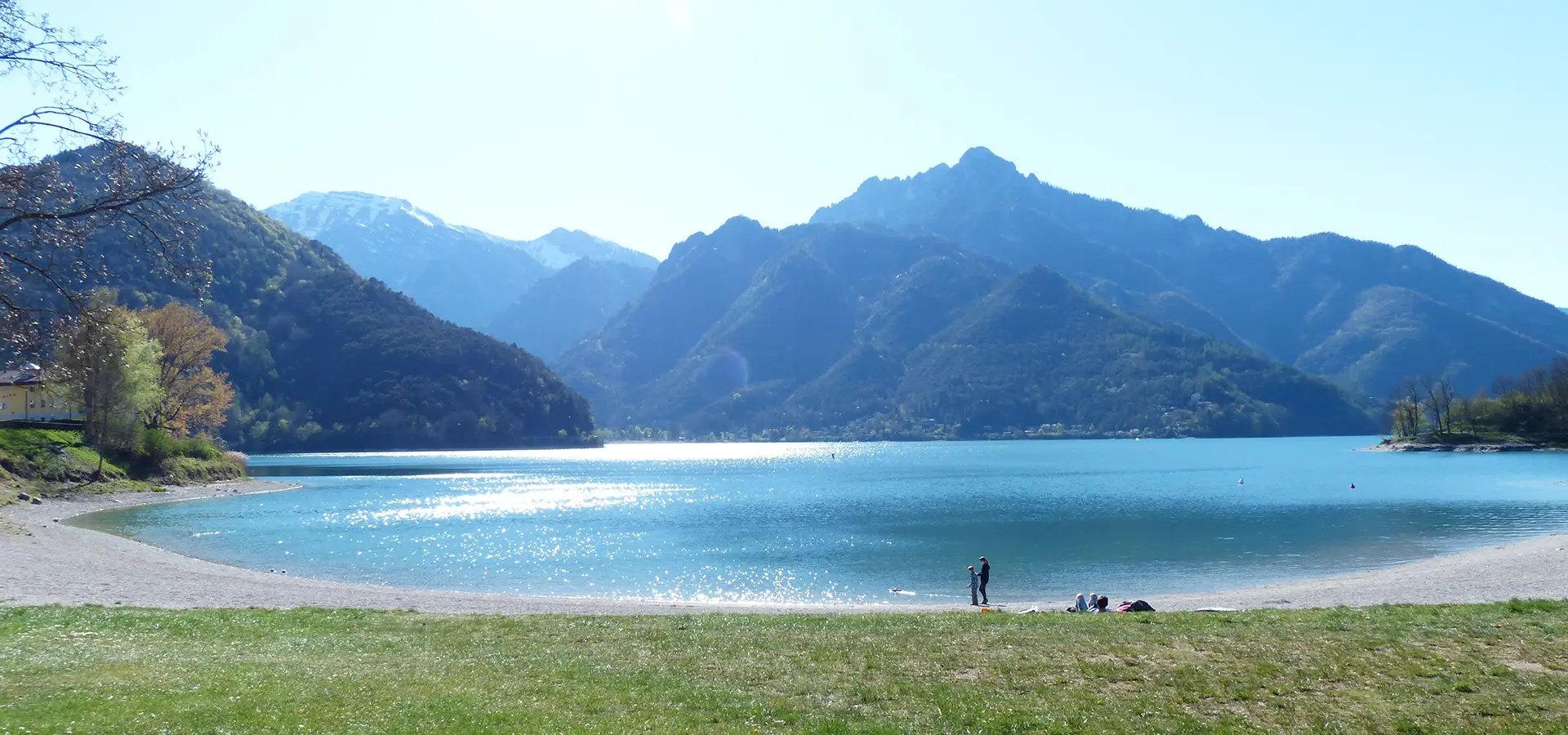
Lake Garda shorelines vary considerably. Depending on the campsite, you may find gravel or stones, grass edging, a built-up shore, jetties or combinations of these. Adults who mainly swim or paddle may like a quick deeper entry; with young children, a clearly visible and easily accessible bathing area often matters more.
Do not rely on the word “beach” alone. Check recent photos and the operator description. Water shoes can be useful on stonier sections, and families should understand how swimming areas, boat traffic and watersports are separated.
4. Do not assume a private beach
A campsite can sit directly on the water yet connect to a public beach or public shoreline. That is not necessarily a disadvantage, but it changes expectations: day visitors may also use the shore and the campsite may not control an exclusive beach area.
If private access matters to you, look specifically for wording such as “private beach” or a clear operator statement. It should not be inferred simply from a lakefront address.
5. Wind, waves and weather are part of waterfront life
You experience weather more directly beside the water. Northern Lake Garda in particular is known for characteristic local winds that help create its strong watersports culture. For campers, that also means awnings, shade sails, lightweight furniture and inflatable equipment should be secured properly.
Thunderstorms and strong gusts can occur elsewhere around the lake as well. On a pitch immediately beside the shore, good weather habits are particularly useful: check the forecast, secure equipment and do not leave SUP boards, inflatables or toys unattended at the water.
6. Think realistically about sun and shade
A lake view is appealing, but shade can be more valuable in July and August. A front row with limited tree cover can become very sunny, while established pitches under mature trees may remain more comfortable. Heavier vegetation, however, can reduce the open view.
For mobile homes, terrace orientation also matters. Travellers who spend the middle of the day away from the campsite may enjoy a sunny waterfront position more easily than a family that spends much of the day around the accommodation.
7. The shoreline may be livelier than expected
Promenades, beach entrances, restaurants, watersports and evening walks naturally concentrate near the water. A front-row position can therefore be beautiful without automatically being the quietest. Early sleepers and families with noise-sensitive young children should check the distance to beach bars, restaurants, entertainment and public paths.
Other guests value exactly that atmosphere. The right question is not whether lakefront is universally quiet or lively, but whether the location fits your own daily rhythm.
8. When is a front-row surcharge worthwhile?
- Very often worthwhile: if swimming, SUP, kayaking and spending as much time as possible by the lake define the holiday.
- Often worthwhile: for couples and relaxed travellers who value views and atmosphere more than being next to the pool or entertainment.
- Not automatically necessary: for families whose children mainly use the water park, kids club and playground.
- Often unnecessary: if you take long excursions every day and use the accommodation mainly in the morning and evening.
9. Our booking checklist for genuine lakefront value
- Is the whole campsite actually on the lake or merely close to it?
- Is your booked pitch or mobile-home category genuinely beside the water?
- Can a particular row or location be guaranteed?
- What is the water access like: gravel, stones, grass, jetty?
- Is the shoreline public or is there a private beach area?
- How far are the pool, sanitary facilities, restaurants and playground?
- Is there enough shade for your travel period?
- Is the accommodation close to a promenade, restaurant, entertainment or watersports area?
Only when those points suit you does “directly on the lake” become more than an attractive marketing label – it genuinely improves the holiday.
